
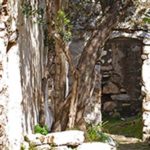
This monastery otherwise known as “Monastiraki” to locals, is located in the island's capital within the neighborhood of Christo. It was first built in 1890, though it has been abandoned since 1955. A large portion of the church was destroyed in the large fire of 1993. Though it holds little interest architecturally, the remains of the monks' cells can still be sen today, as well as a wall overlooking the west.
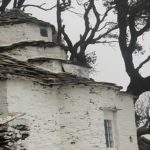
Located between the villages of Oxe and Mavrato, this church represents an important piece of the island's history and culture. Remains of monks' cells, and an icon depicting St. Onoufriou can be seen within the church's interior, while a marble plaque adorns the outer wall of the monastery. The grounds of the complex contain gardens and vineyards which the monks cultivated, as well as the ruins of a kiln, where the monks created and later sold ceramic wares. The remnants of an olive press can also be seen, as well as a hawthorn tree, which grows throughout the highlands of Ikaria and is prized among the islanders for its healing properties.
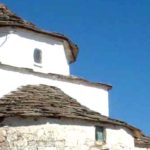
This church can be found in the western side of the island, a few kilometres south of the village of Nanoura. From an architectural point of view, the church doesn't stand out; only a marble column base and various marble and clay fragments point to the existence of an ancient settlement or temple which once stood in the same location. The sanctuary of the church contains a wood carved statue that dates back to 1820, as well as an icon of the Virgin Mary.
Near the village of Xilosirti, a few kilometres outside of Agios Kyrikos, stands the Holy Monastery of Evangelismos, in the area of Lefkada. It was built in the 18th century by two priests from Agios Oros, who took refuge from pirates on the island, and build this church dedicated to the Virgin Mary. In 1955, the church was turned into a monastery for women. Today the small chapel of St. Makarios has still been preserved, featuring the cell where the saint stayed, as well as mosaic floors underneath which, a crypt is located. A bit further from the main church, lies the confessional of the nuns, as well as two mills, an olive press, and the docks where monks kept their boats. Enough of the structure has survived to warrant a visit.
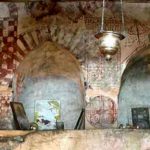
This relatively unknown church near the village of Amamatra, represents one of Ikaria's prized gems. The small, single-spaced church consists of two marble dividers which separate the inner and outer sanctuaries. As one of the oldest churches on the island, it features several colourful frescoes.
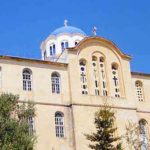
The capital of the island takes its name from this young martyr, who also happens to be Ikaria's patron saint. According to historical sources, Kyrikos and his mother Ioulitta were martyred in Asia Minor at Tarsus during the 4th century A.D. And were canonized by the church, with Kyrikos possibly being Orthodoxy's youngest saint, losing his life at just three years old. The church was built between 1902 – 1911 under the auspices of Belgian architect Eugene Dypre. Architecturally speaking, it's a three-aisled cruciform basilica with an impressive dome, that is visible from ships approaching the island's harbour. The church was built by G.S. Fountouli while the inner sanctuary is the work of A. Vlachogeni. The icons were painted on marble plaques by the painter Nikos Sitara of Samos.
This church is the oldest remaining of its kind within the old town of Agios Kyrikos. Located in the capital's central square. According to historical accounts, the sanctuary was built sometime between 1820 and 1840, while the bell tower dates back to around 1860. During the construction of the church, foundations of an older church were found, which date back to the first years of Christianity on the island.
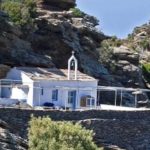
The small chapel of St. Sofia is built on a rock north of the village of Monokambi. According to local tradition, Zacharias Karapetis, a native Ikarian who had immigrated to the U.S., had a vision of an icon in the cavity of the rock on which the church is built today. After painstaking excavations done by the villagers on site, the remains of St. Sofia and her three daughters were found. The are said to have been brought to the island by a monk from Ioannina named Ioannis Muraios, in an effort to save their remains from the Turks. Karapetis managed to build the church on this site. Later, a portion of the bones were stolen, though the rest of the remains can be found on site.
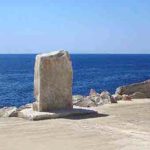
Located in the middle of the sea, about 20 metres from the village of Chrysostomos, lies the rock of mythological Icarus, who is said to have lost his wings and fallen into the sea at that point. A small stone amphitheatre has been built on site, and many various events are frequently held there. In a field across the water, lie the pieces of a broken iron mine cart, which is referred to as the “blood of Icarus”, according to local tradition.
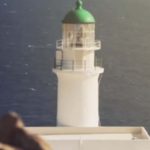
The lighthouse of Cape Papa has been declared a cultural heritage site. Built sometime between 1886 and 1890 by the French Lighthouse Company while the island was still under rule of the Ottoman Empire. The lighthouse illuminates one of the central Aegean's most treacherous passes – that between Mykonos and Ikaria. It hone for the first time on May 20th, 1890. During the years of WWII, it was turned into an armory by the Italians and remained unlit due to damages it had sustained. It began shining again in 1945 as its damages began being repaired. With a focal height reaching 75 metres, its light can be seen from 2.5 miles away, with a characteristic white blinking light every 20 seconds. The height of its cylindrical tower is 11 metres and contains 32 stone and metal steps leading towards the top.