
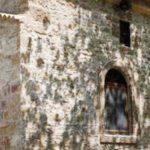
Its name means the Begging Saint: Eleoussa asks for protection for the region's residents who were subjected frequently to wars and challenges. Today, only parts of the tower and the church have remained.
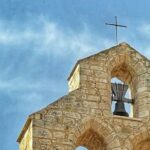
This is a very old structure that lies partly in ruins. More Frankish rather than Byzantine, it is now a place where concerts are sometimes held outside. It is very atypical of other churches in the region and quite impressive.
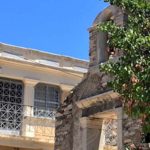
Located within the archaeological site of Kambos, this museum contains artefacts from the areas of Kambos (ancient Oinoe), Nas (temple of Tavropolio Artemis), Arethousa, Christos Raches, Proespera and Frantato, among many others. Within the museum's exhibits, visitors will find pottery, statues, grave goods, sarcophagi, idols and building fragments. Of particular interest is a marble sarcophagus dating back to the Late Archaic period. It's believed to have been produced in Asia Minor and features carved reliefs of fruit, garlands and roses.
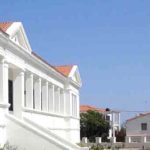
A true gem of the island, this museum is housed in the former junior high school of Ikaria's capital. The building itself is impressive, as an excellent example of neoclassical architecture dating back to 1925 and featuring unique pediments and a large, marble staircase leading to the main entrance and front yard of the building. Inside, the museum contains over 200 artifacts which have been unearthed throughout the island and the waters surrounding Ikaria. Visitors have the opportunity to see pottery, columns, stone and bronze tools, well-preserved amphoras, pedestals, pillars, clay wares, weapons and other personal objects. The most important of these is the funerary sculpture of Katafygi, a work of an artist from Paros dating back to the Archaic/Early Classical period.
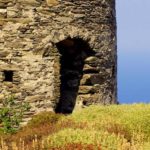
Perdiki castle gets its name from its location just outside a village bearing the same name. It's also known as the castle of “Lefa” or “Kephala” from the impressive slope of the rock also called Kephala. Reaching the castle is only possible on foot via a path which leads towards Faros and passes through the old settlement of Skales, where hikers can see the old, deserted houses and graphic church of St. Stavros.
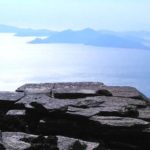
This castle can be found in the eastern part of the island. It stands at an altitude of 800 metres within the Athera mountains and can be accessed by a single path which starts at Mavrato and continues towards Karavostamo. The castle's location and its imposing views over Ikaria's entire eastern region suggest that it once acted as an important fortress and look-out point. Unfortunately, only fragments of the castle have survived but its impressive views make the journey worth the while.
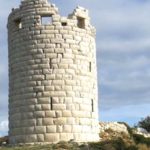
The ancient city of Drakano once stood in the area known today as Faros (Fanari) on the eastern edge of the island, and included the acropolis and tower of which, ruins can be seen today. The tower represents the city's most well-preserved building as it stands at an altitude of 50 metres and affords visitors incredible views of Samos and the Fourni Islands in the distance. Form a construction standpoint, it is considered an impressive work of art and remains as one of the most well-preserved towers throughout the entire Aegean.
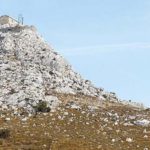
Just outside the village of Kosoikia Evdilou in the northern part of the Ikaria, lie the remains of the Castle of Koskina, at the peak of Mount Koskinas. Also known as the castle of “Messarias” or “Nikarias”, the structure was once a strong fortress during the Byzantine Era and later, the Frankish rule. The Byzantines built the castle at the top of a conical hill around the 10th century A.D. Due to the excellent visibility it offered, a small military base was established at the site, allowing soldiers the ability to survey the entire area, both over land and sea. Today, multiple fragments survive. The wall surrounding the top of the hill can be accessed by the entrance at its northern side. Within the inner area of the hill, the church of St. George of Dorgana still exists, with ancient columns standing within its interior. At the northwestern side of the hill, crumbling remains of a settlement can be seen. According to legend, the castle was never penetrated, except on one occasion due to treason. Despite a path making it accessible, the castle sees few visitors due to its remote location.
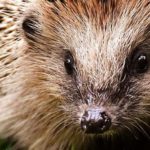
Due to its great variety of landscapes and habitats, a large number of fauna can be found throughout Ikaria. Some noteworthy examples are the hedgehog, which can be found in the plains of Fanari, endemic species of reptiles originating from Asia Minor, such as the Turkish lizard (Lacerta oertzeni) the gecko (Hemidactylus turcicus, the skink (Ablepharus kitaibelii), the snake-eyed lizard (Ophisops elegans) the starred Agama (Laudakia stellio) the wall lizard (Lacertidae lacertinae) and the Lizard of Ikaria (Lacerta oerizeni) which is only found on the island. Some of the most frequently seen snakes of Ikaria include the Caspian whipsnake (Coluber caspius), Eastern montpillier snake (Malpolon insignitus) as well as the protected Ottoman viper (Vipera xanthia).
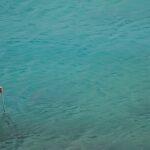
The cape of Fanari is located in the northeastern edge of Ikaria and features sheer coastal cliffs and beaches. As frequently found throughout the Mediterranean, the area consists of important sea ecosystems found along the coastline and under the water, where sea grass grows in abundance on the seafloor. It's an important haven for both the Mediterranean Monk seal (Monachus monachus) and the Loggerhead Sea turtle (Caretta caretta).