
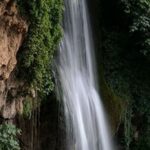
The three estuaries of the Halari, Voutside, and Mirsona rivers are located respectively within the areas of Nas, Kambos, Gialiskari and Armenisti. All four rivers flow year round with brackish water and serve as a natural irrigation system to the small cultivations scattered along the riverbanks. Additionally, these wetlands feature rich biodiversity of both flora and fauna, among them a large number of protected and endemic species. A large variety of trees and bushes can be found here, such as reeds, bushes (oleander and schinous) and trees (alderwood and tamarisk). Several types of birds, amphibians and reptiles also inhabit the estuary. The Halari Gorge is home to several rare and protected species, among which are the Turkish lizard, river otter, a rare type of freshwater crab, and a bottom-dwelling fish of the salaria genus. Most interesting of all is the European eel, a species which migrates from America, crosses the ocean for three years before reaching the rivers of Ikaria. The gorge also provides shelter to dozens of permanent and migratory birds, such as falcons, egrets and bitterns. Overgrazing and extreme draining for agricultural purposes pose the greatest risks to the estuaries' ecosystem. Recently, increased tourism during the summer months has also had a negative effect, as the estuaries frequently drain into beaches full of tourists.

The man-made lakes of Vathes and Pezi are respectively found in Kastanies and Christos. Both were created by dams on the rivers of Mirsona and Halari, and both wetlands are located within an area designated for the protection of birds. Dense vegetation grows around the lakes' borders, and most of the greenery is in the form of trees, such as pine, plane and oleander trees, as well as wicker and schinias bushes, and reeds. Not surprisingly, the area is inhabited by a large variety of birds, reptiles and amphibians.
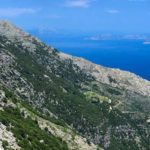
Ikaria is a mountainous island and the mountain range of Atheras (Pramnos) cuts through a large section of it. With its highest point reaching an altitude of 1,042 m., the frequent occurrence of fog and mist create high levels of humidity during the entire year. A closer look throughout the thickets and protected areas of Ikaria, reveals that the island was once completely covered by forests. Even the mountain range's limestone cliffs shelter several types of endemic plants. Caves dot its coastal cliffs, and have ben known to be inhabited by the Mediterranean Monk Seal. Overgrazing of goats, arson (with the intent to create more grazing found) and the extension of the island's road system, all threaten the survival of the region's ecosystem. As one of the island's chief protected areas, its thick vegetation is home to several rare plant species as well as a variety of birds, amphibians and reptiles, such as the “Lizard of Ikaria” Lacerta oertzeni certzeni).
Located just west of the Athera mountain range in the central section of the island, lies the Randi Forest. Estimated to be over 200 years old, it features trees dating back to over 300 years, making it one of the oldest remaining forests throughout the eastern Mediterranean. It's the home of a rare, protected type of Oak tree (Quercus ilex), which is believed to have evolved around five million years ago. Other species of trees found within the forest include Arbutus and Fyllyrea trees, as well as a variety of bushes, such as yew, heather and cistus. Several animals call the forest home as well, such as the rock badger, marten, (Martes fiona), the hedgehog (Erinaceus concolor) and different types of rodents.
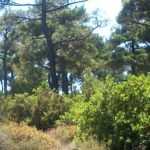
The island of Ikaria is one of Greece's most impressive and important ecosystems, featuring a rich variety of both flora and fauna, as well as various landscapes made up of lakes, rivers, springs and caves. Additionally, there are several wetland areas throughout the island which are worth visiting. Many of Ikaria's prized natural sites are officially protected and belong to the Natura 2000 initiative within the categories of Areas of Exceptional Natural Beauty, Important Bird Areas, and CORINE Habitats.
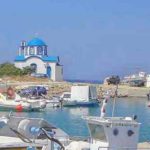
The church of the Ascension of Jesus can be found in the quaint village of Gialiskari. The spot on which the church is located was formerly an island, where a returning native Ikarian decided to build a church.
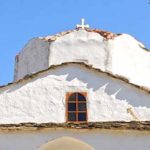
One of the most important Byzantine monuments of Ikaria is the church of St. Irene, which was built on top of an early Christian basilica, parts of which, can still be seen today. At one time the church's foundation had been dated between the 9th and 10th centuries, though it has recently been revised to somewhere during the 11th or 12th century A.D. Belonging to the simple, four column cruciform style, the church is rectangular, with the points of the cross supported by gabled roofs and a dome which stands atop an eight-sided drum. The church's roof is covered by slate shingles, while the original walls have been re-coated.
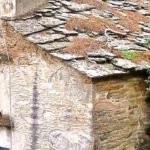
Though small in size, this chapel is a local gem, featuring original Ikarian architecture and dating back to 1806. Today visitors can visit the church which leds between the villages of Christos and Agios Dimitrios within the area of Raches. Within the church's interior, visitors will see ornate frescoes and a wooden cross above the mantle. Also of intererst are a copy of the Holy Gospels dating back to 1872, and a liturgical pamphlet from the 19th century. Near the monastery lie the remains of an old watermill which supplied the village of Christos with water.
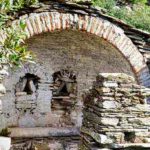
This sanctuary features some of the oldest remains of a Christian church on the island. It's located near the village of Miliopo, in the northern part of the island and is known by the locals as the Church of Taxiarches. The first phase of its building dates back to the 4th century A.D. The church is 15 metres long and 6.5 metres wide, and consists of the arch of the pulpit, the square altar, two marble plaques and mantles, as well as columns made from real marble.
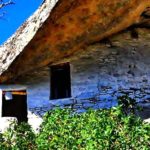
This monastery is located near the village of Pigi in the northern part of Ikaria, and is dedicated to St. Theoktisti from Lesbos. The date of its foundation remains unknown, though it is sure to have been in operation from at least 1688, when the church's sanctuary was painted, as an original inscription reads on its southern wall. The entire complex is comprised of the sanctuary which contains elaborate frescoes, 15 cells and various other facilities. Just a few metres from the sanctuary lies the chapel of Theoskepastis, built into the interior of a cave, below a large rock formation. According to local tradition, when the villagers discovered the remains of the saint within a crypt located behind the sanctuary, they brought them to the cave and designated the area as a chapel. Within its interiors remains an old wood-carved mantle dating back to 1894.