
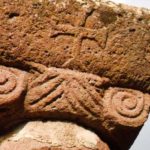
If you love exploring early Christian architecture, the remains of the Basilica of St. George is a must for you. Admire the masonry and you’ll be able to envision what this ancient basilica once looked like at its grandest, with its three aisles and elaborate roof.
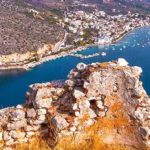
If you're a fairly good swimmer, this is one fort that's for you. It lies on an islet off the coast, ready to be explored. Head to Tolo with its clean beaches, although slightly touristy, but with a surprise in store for those who seek quite mystery. You can literally swim the calm waters to one of two close-by islets to explore the remains of a medieval castle left over from Frankish times.

Serenely lying on a hill, the Kazarma Citadel or Acropolis is located on the 15th kilometre of the Nafplio-Epidaurus highway. The citadel boasts four circular towers and walls that are 2.5 meters wide and 5.2 meters high. It has a polygon shape and dates by some accounts from the fourth century BC! It was rebuilt however in Roman times, then in Byzantine times.
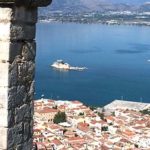
At 216 meters above sea level lies the majestic castle of Palamidi overlooking Nauplio. It was built by the Venetians during their second occupation of the area, i.e. between 1686 and 1715. This is a fine specimen of a baroque fortress, which was taken over by the Ottomans until 1822 before being liberated by the Greeks. Some of the walls have been restored, particularly the wall of the castle and some of the weaker parts. The castle is composed of eight bastions, surrounded by the walls. You can climb up using a long stairway. Also note the Church of Agios Andreas actually built within one of the bastions.
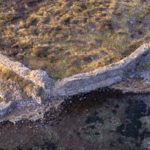
History and archaeology buffs will enjoy exploring this site, with sprawled remains of a medieval fortress as well as pillars and marbles dating to earlier times. Walk around this site and hike down to the bays below for a refreshing dip before stopping by a seaside taverna for lunch.
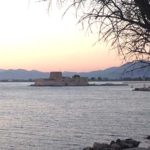
Attractively obvious from the lovely town of Nafplion, this is a fortified little island in the town's gulf built by the Venetians somewhere between 1390 and 1540. The architecture was updated during the renaissance period and eventually occupied by the Ottomans in 1715. In the 50s it actually functioned as a hotel. It can be reached by boats from the harbour of Nauplion, and sometimes hosts concerts.
Also known as the Fishermen's Citadel, part of Alies has sunk underwater. The walls were 186 meters long and 2.5 meters wide, reinforced with circular and square towers. The foundations of these walls and towers are from porous rock, while the top part is made with river stones, bricks and tiles. There was also a religious centre inside the citadel, with an altar from the 4th century BC and ruins from the 5th and 6th. Evidence of workshops and residences can also be seen at the site.
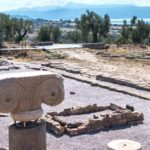
Dating back to the 6th C, this beautiful temple is unique in terms of archaeological importance as it’s the only example of Aeolian architecture in Greece. It once held the Altar of Lesvos and was one of the most significant religious temples in Lesvos.
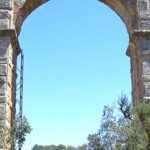
Dating back to the 3rdC AD, this stunning 170-meter Roman aqueduct was one of the most important and earliest types of infrastructure built on the island. With 17 huge grey Lesbian marble arches belying its rather mundane function, you’ll be able to admire Roman technology when you explore this aqueduct that carried water throughout the island.
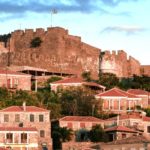
For a trip back in time, explore this stunning Medieval castle overlooking this beautiful town. Built by the Byzantines and the Genoese Gattelusi family, you’ll fall in love with its imposing allure. Admire the thick oak door plated in metal that opens to the center of this Byzantine castle and the stunning views it affords over the Aegean. Take in a concert or play – as a cultural venue, this castle is unbeatable.