
Built in 1914 by Bishop Seraphim Domvoiti, the architecturally beautiful clock overlooks the city and can be reached from the church of Agios Dimitrios. Visit in the afternoon when the sun lies low and reflects against the clock.

A park of plants and monuments dedicated to the heroes of the region, this space is nature's way of making amends with a troubled past. There is even a monument for Philhellenes from France, Germany, Italy and Poland who took part in the Greek war of independence, as well as a marble statue of the poet Byron.
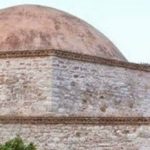
Built by Sultan Bayazit Veli, son of Mohammed II (1446-1512), in reconnaissance of God for the seizure of the city of Nafpaktos in 1499, the mosque was the first in the city. When Christianity returned, it became a commercial establishment. It was recently renovated however and is now used for cultural events.
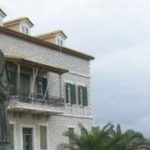
Belonging to the Kapsali family, the mansion is home to the Messolonghi Byron Society dedicated to Lord Byron's life and poetry.The celebrated English poet and Philhellene Lord Byron came to the city to support the Greek revolutionary cause and died in Mesolongi in 1824.
Little remains of the walls from this fortification near the area of Stefani just southwest of Mourtia. Though only mere pieces of the castle walls have been found, several artefacts dating back to the Classical era have been unearthed here.
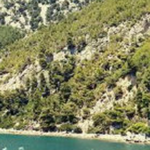
West of the village of Dafni in north central Evia, ruins of a castle can be seen on a low hill at Kastro, near the road heading to Strofilias. The structure dates back to the 5th century BC, though a large number of artefacts including statues and pottery as well as graves have been found in the area and suggest that it was inhabited from the Geometric era.
Overlooking the peaceful seaside village of Oreoi, the remains of a once-grand castle stand sentinel. Built up during the period of Frankish rule, the castle was inhabited continuously throughout the Byzantine and medieval periods. Further excavation throughout the area revealed traces of buildings dating back to the 4th and 5th centuries. Today little remains, though the views over Oreoi and the sea make the journey here worthwhile.
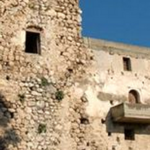
A well preserved and hauntingly beautiful Venetian tower sits in the centre of the picturesque seaside village of Rovies. The three-storey tower which dates back to the 13th century houses the community’s public collection of antique tools and objects of the town’s past.
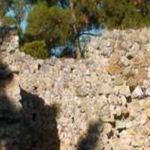
In the seaside town of Loutra Aidipsos stand the ruins of a Frankish tower believed to have been the residence of the former Baroness of Aidipsos and Lichada, Petronella Tokko.
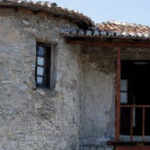
The charming village of Gouvies just 15 klm. Northeast of Istiaia is home to what is today referred to as the Drosini Tower.