
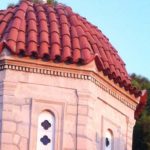
Like a majority of other Greek islands, Aegina is home to hundreds of churches spread throughout its landscape. However, no other island can boast one of the largest Orthodox churches in the southern Balkans as well as a site as captivating as the the deserted village of Palaiohora containing several churches, some of which date back to the 12th century.
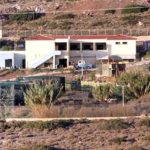
Aegina is the proud home of the Hellenic Wildlife Hospital (EKPAZ) located just outside the mountain village of Paxia Rachi. It's the oldest and largest wildlife rehabilitation center in Southern Europe and treats upwards to 4500 animals every year.
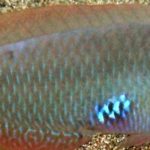
Aegina's forests and mountains are home to several types of land mammals including foxes, hares, and badgers. Additionally it's one of the few areas in Greece which contains a marine environment that sustains a rarely found fish known as Katsoula. It's one of the most delicious fish in the Mediterranean and for this reason its whereabouts are a closely guarded secret.
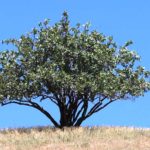
All over the Aeginian landscape you'll find beautiful flowers and trees. The island is best known for its pistachios but olive and almond trees are also found frequently around the island. Pine trees are also abundant on the island, particularly in the north. Another aspect of Aegina's landscape are the beautiful flowers that spring up in its valleys and hills such as the Grape Hyacinth and the Purple Orchid.
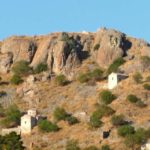
Despite the fact that Aegina was invaded and occupied by the Frankish and Venetian empires, the island has no surviving castles aside from the ruins of a Venetian castle high on the hill of Paleohora. Though little remains, the area itself certainly deserves a visit as it is one of the most unique landscapes of Aegina.
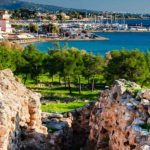
The remains of this 6th century sanctuary lie atop the hill of Kolona. It only contains one column, which gives the entire site its name (kolona means column in Greek). The temple itself was rectangular and comprised of 6 columns width-wise and 11 lengthwise. The site also boasts the remains of a temple to Artemis and an archaic cemetery containing graves in which gold jewelry was found.
This magnificent Doric temple lies just 2 kilometers east of Mesagros on a hill overlooking the turquoise waters of the sea. Impressively 24 of its 34 columns remain, making it one of the best preserved ancient sanctuaries in all of Greece. It was built sometime between 500-480 and its pediments contained scenes of the Greek victory in the Trojan War.
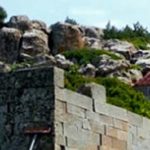
The evocative ruins of this Temple to Zeus lie on top of Mt. Ellanio (also locally known as Oros). The mythical King of Aegina, Aiokos, appealed to the God to send rain during a long drought on the island.
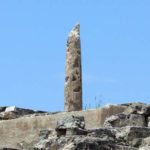
The remains of a Neolithic settlement have been found on the hill of Kolona just one kilometer northwest of Aegina Town.
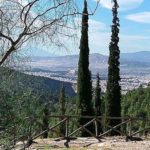
It's name comes down to us from pre-Hellenic times, Mount Hymettus or Imittos is only one hour's walk away from Downtown Athens. In fact, Athenians used to cut its trees for wood up until the 1950s, when the Friends of the Forests organization changed this.