
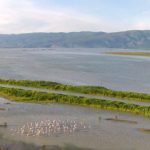
The ecological abundance of this area is evident through a broad variety of characteristics such as a mountain, two wetlands, a spring and several natural habitats.

Five vaulted tombs from the Mycenean era have been discovered on the west bank of the black Karanteres stream, complete with many votive offerings. Another was found west of the village of Megalo Monastiri.
Located on the northern edge of the ancient city, the temple is one of Thessaly’s few ancient sites where archaeological excavations took place. The Doric temple had 6X6 columns and is dated to the end of the fourth century B.C.
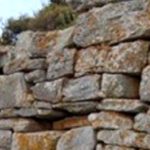
The ruins of this ancient walled city on Meria hill have piqued the interest of archeologists, representing one of the most important on the Kapourna plateau. The city, which is yet to reveal its secrets, was inhabited for a long time and is within walking distance from Volos. Source: wikimapia.org
Three rocky hills lying 3.5 km east of Sotirio were most likely islands in the middle of ancient Lake Voiviida (today Lake Karla) were once surrounded by Mycenaean walls. The area revealed finds from ancient, classical and Byzantine periods.
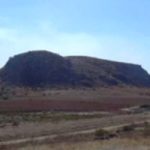
Four ancient mounds (magoula) in the Kalamaki area of Magnesia attest to continuously inhabited areas from Neolithic times. Another mound dubbed Asimohoma lies in the Larisa region near Melissa, with a 5-meter-high tomb from the Classical era.
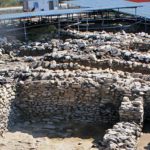
This is one of the most important prehistoric settlements of the region, excavated at the western foothills of Mavrovouni not far from Lake Karla. The center of the village shows sophisticated stone buildings from Neolithic times (5th-4th centuries BC). Source: dimosagias
Neolithic remains have been found around the village of Melissohori, including two anthropomorphic figurines of humped women. There are also tombs and finds from the Classical era in this area.
Several Neolithic settlements have been found around Nikaia. There are Roman steles with inscriptions, as well as steles from Impsio and Poseidon Zeuxanthion dating from the Hellenistic years. Nikaia may be sitting on the site of Ancient Chalce (Halki).
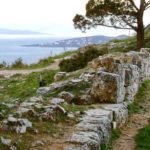
Deep in the Gulf of Pegasus (or Pegasitic Gulf in Greek), east of Volos, lies a commanding hill with a very strategic view in ancient times, where Phillip II built a city. Its name remains unknown, but could be Nilea, Orminio, Iolkos or Dimitriada.