
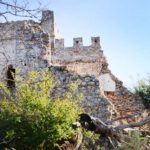
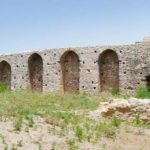
Nobody is sure when the castle was built, but there are elements of Mycenaean architecture in its walls. Four turrets and restorations took place during Byzantine years, although only one turret remains today. An one time the castle had an acropolis overlooking the sea.
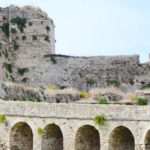
On the southernmost tip of the western side of the Peloponnese lies the impressive castle of Methoni, with evidence of fortifications dating back to the 7th century BC. It served as a Byzantine fort until 1204 AD, passing five years on to the Eneti who established a commercial port and fortified the castle along the lines of Venetian architecture. On a small island to the south of the castle lies the Bourtzi, an octagonal tower-like fort with symmetrical walls.
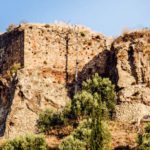
The castle of Kalamata is supposed to be on the site where the palace of Ortilochos of Pharai and subsequently of Diocles was, between 1580 and 1120 BC. The current medieval castle was built much later by the Knight and historian Geoffrey of Villehardouin in 1205 AD. The Byzantines and the Ottomans added to the structure. The lion of Saint Mark graces the entrance of the structure, reputed to be from the Eneti (also Heneti or Veneti) peoples who lived there millennia ago. Fragments from the Mycenaean and Roman eras have been found on the site, in addition to Hellenistic and Roman tombs. A small Byzantine temple remains close by, supposedly dedicated to the Virgin Mary of Kalomata (which may be the origin of the name of the city Kalamata).
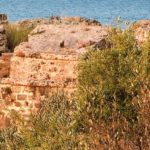
In the south of the town of Koroni lies the castle of Koroni, which was original a simple structure. It evolved into a Byzantine fort that was consequently invaded by the Franks during the 4th crusade, around 1205. While not much of the castle remains today, there are a couple of significant churches and monuments around from different eras. Tombs, Turkish baths and Venetian reservoirs and magnificent storage domes are still preserved.
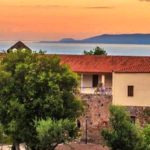
Only 7 kilometres away from Kalamata, this monastery is over 300 years old, founded in 1697. There used to be a tower which was destroyed over 100 years ago. This monastery played an important role during the war of independence and Ibrahim Pasha destroyed it in 1825. This happened again during the German occupation. Reconstruction began in 1992.
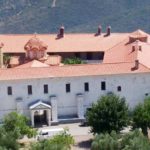
Also known as Vourkano, this monastery is located on one of the holiest areas of ancient times. It is placed on a mountain on the ancient site of Ithomi, standing out and looking all over the plains. Monks abandoned it because of its difficult access and exposure to too much sun, cold and wind during the seasons. The nave is of noteworthy design by the Moschos brothers in 1608. Nearby are ruins of the ancient temple of Zeus were animal and maybe even human sacrifices took place.
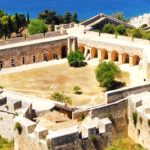
In reality, there are two castles on Navarino Bay near Pylos, the older being Paliokastro (literally old castle) built by the Franks and the more recent being Niokastro (literally new castle) built by the Ottomans. The impressive hexagonal Niokastro, more like a fort than a castle, functions as a centre of submarine archaeological research and a museum. At certain points the castle functioned as a mosque and then a church.